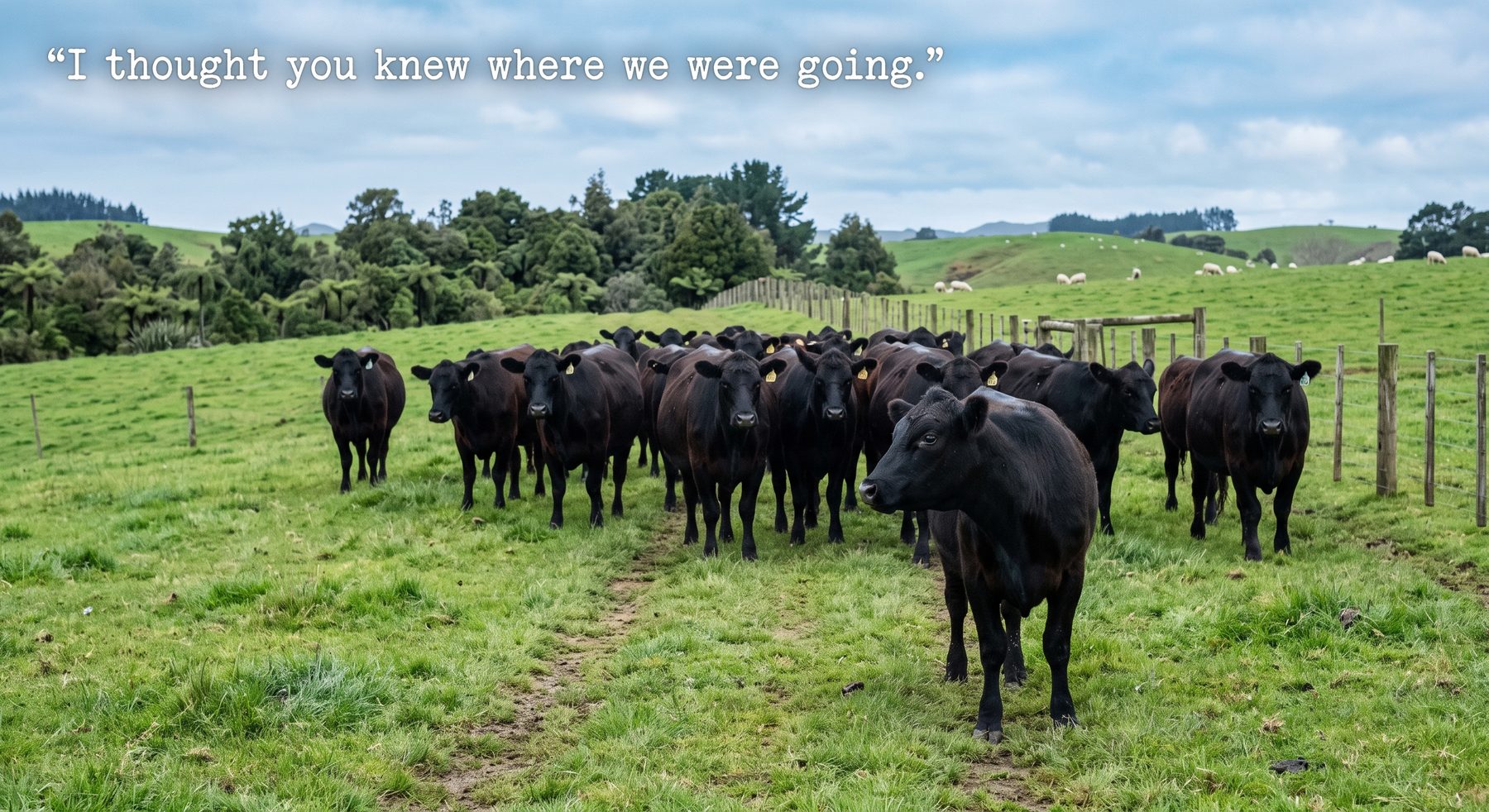
"Everyone down my road has already sold their bulls," he said, leaning on the rails.
Uh oh. Are you wrong to still have yours on? Are you missing the boat?
Five minutes ago, you were comfortable with your feed position. Now you're wondering what everyone else knows.
The question in your head shifts from "how dry will it get?" to "how much will it cost me to be last?"
That shift deserves a closer look.
Getting inside your head
In the 1950s, psychologist Solomon Asch asked people to match the lengths of lines on cards. The answer was obvious — you didn't need to be a maths genius. The catch was that everyone in the group had been told to give the same wrong answer in selected rounds, or at least everyone except the true participant, who was unaware the rest of the group was part of creating the conditions for the trial itself.
About three-quarters of the true participants went along with the clearly wrong answer at least once. Some doubted their own judgement, others struggled with standing apart from the group. About a quarter held their ground throughout.
Most of us would like to think we would be in that last quarter. Maybe in the same way that 90% of all farmers rank themselves in the top 50%… (note that last stat is mine, not official!)
But selling bulls is a more complex decision than matching line lengths. There's no answer card to check against until long after the moment has passed. Your neighbour might know something you don't: a change in plant backlog, a buyer stepping back, feed situations elsewhere deteriorating more quickly.
Watching what other people are doing can be useful. The difficulty is knowing how much fresh information — that you don't have access to — sits behind their decisions.
From one decision to "everyone knows"
Economists have a name for a version of this: an information cascade. People follow others' earlier decisions even when their own information points elsewhere. Once that happens, another person joining the crowd may add very little independent evidence. This apparent consensus can be more fragile than it looks.
Imagine one farmer sells because he is short of feed. Maybe a kale crop didn't yield as expected. Another sees the trucks and wonders if the market is about to turn. A third hears that those two have sold and books their space as well.
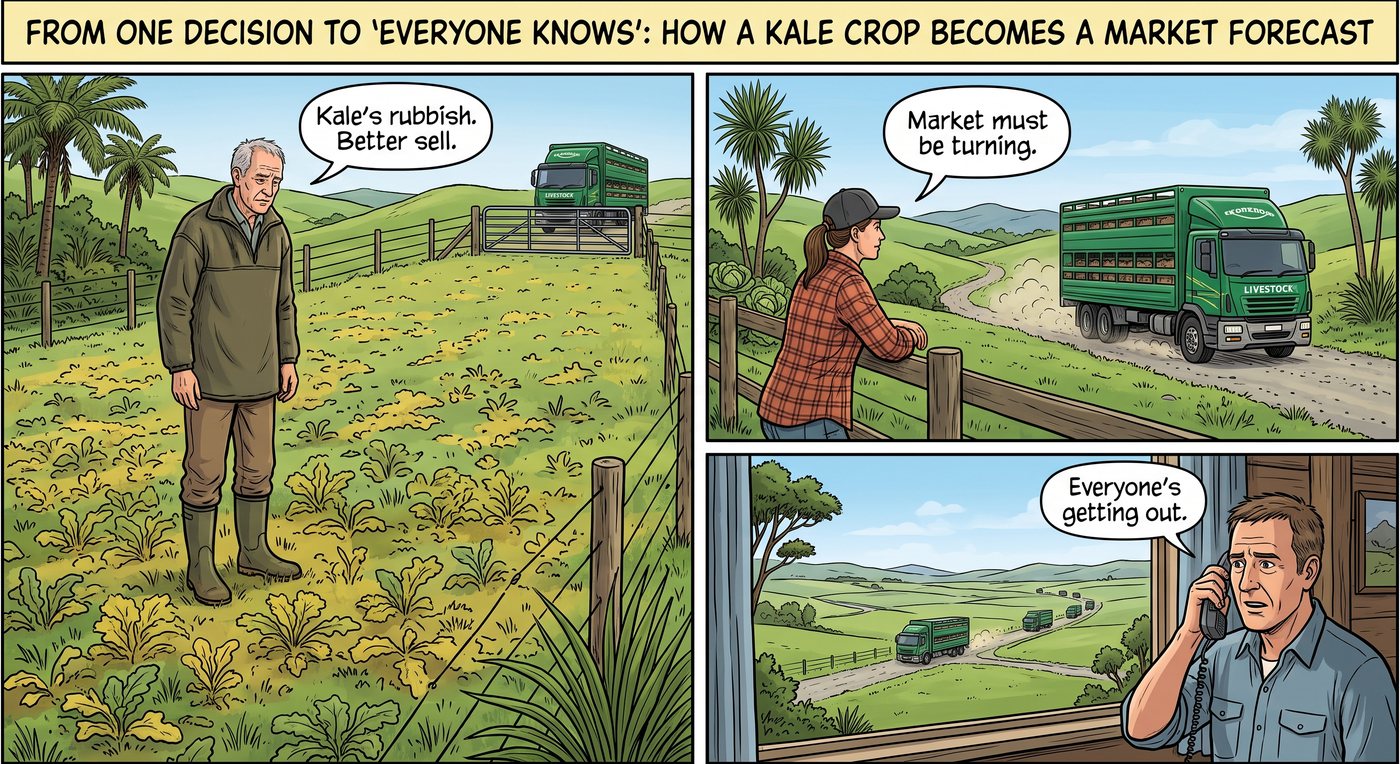
By the time you hear the story, "everyone's selling before the price drops". But how many assessments of the market are actually behind it?
It is entirely possible several neighbours might independently reach the same sensible conclusion. They could all be seeing their pasture growth rate drop off a cliff. But a similar decision outcome alone — sell cattle — doesn't tell you whether you're seeing a cascade or a shared problem.
Missing the bus
Then, there's that feeling of urgency.
Psychology has given us a newer concept to hang our hat on for that — fear of missing out, or FOMO. A widely cited 2013 study described it as apprehension about rewarding experiences others might be having without you, particularly in the context of social connection.
There's a farming parallel here, although the stakes are rather different. Heading into a dry spell, the thing you fear missing is the chance to get stock away — while you still can.
Hungry animals. Falling prices. A backlog at the works.
That's a real business risk. Selling early can be a perfectly sensible response. But it can also be a bit tricky to tell how much of the urgency comes from your own situation versus how much comes from watching others head for the gate.
"I'd rather be wrong with everyone than right on my own," starts to feel pretty reasonable.
But… the crowd can change your options
The awkward bit — once enough people act, they can change the market you're participating in. Sales brought forward, fewer (or no) people buying at a price that will pay the bills, tight works space on a falling schedule.
Sociologist Robert Merton enters the chat, from way back in 1948, introducing the world to the concept of "the self-fulfilling prophecy". We expect something to happen, that changes how we act — and that new behaviour causes the original belief to become the real outcome.
Your neighbours' decisions can consequently matter to your business even when their farms, feed positions, and reasons for selling are different to yours.
Back on your side of the fence
- What new information do I have? Has the outlook changed? Are the meat companies on the backfoot for space? Or have I heard the same story from several people?
- What is my position? What does feed look like if pasture growth follows expectations, is better, or worse? How much scope have I got to be wrong?
- What would make me act? Your lines in the sand — what pasture cover, price, backlog duration, cash requirement would trigger an action?
Risk comes with upside as well as downside — there may be an opportunity when sellers outnumber buyers and you have feed available, or planted a sneaky spring-sown forage crop. Whether it stacks up depends on a lot of factors, a workable exit being a key one. Cheap stock can become expensive mouths.
Back at the rails, "everyone's sold their bulls" is a great prompt to you to check your plan.
Field notes is written while building farmBI. If you'd argue with any of this, I'd like to hear it — that's most of what the pilot is for.